
A more sacred place for the British race does not exist in all the world.
Winston Churchill, 1919
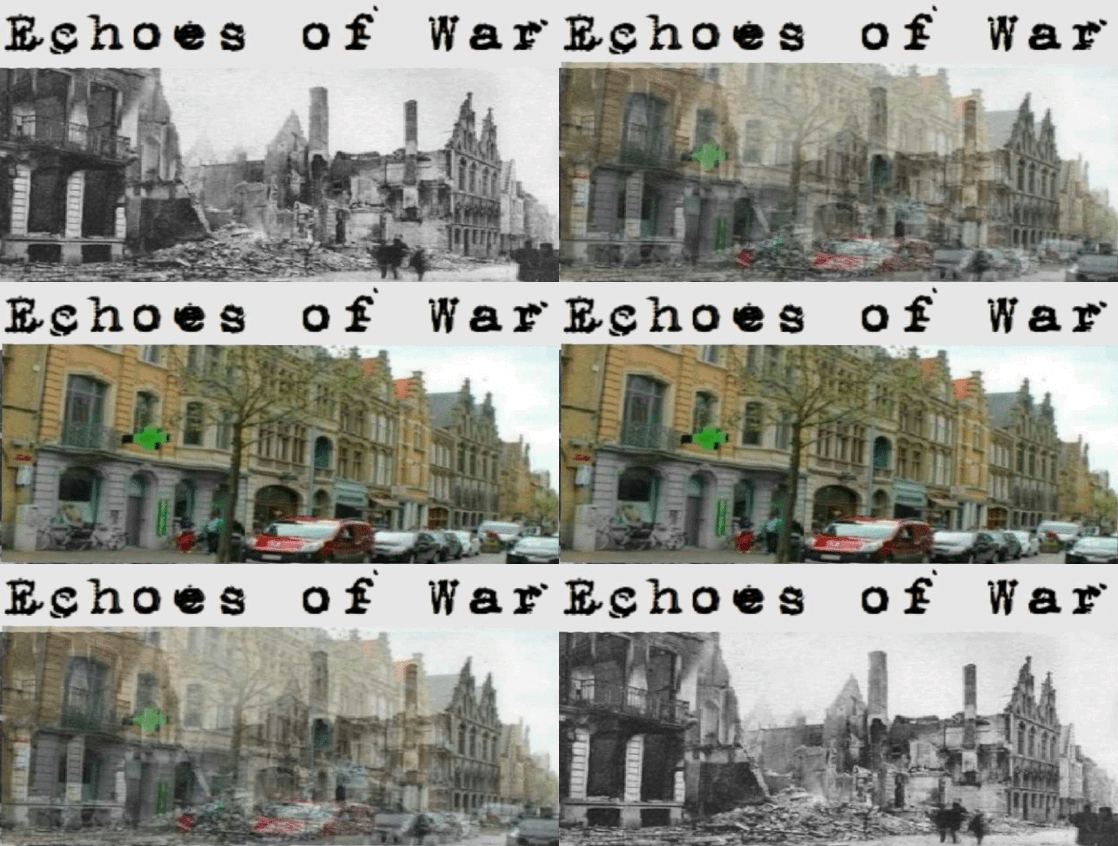
In the Middle Ages Ypres became world famous because of its cloth trade. Commercial relations flourished, particularly with England, which provided much of the wool on which the town’s great prosperity was based. The most obvious symbol of this prosperity was the magnificent Cloth Hall, built during the 13th century. Ypres was occupied by the German army for one night at the beginning of the Great War and recaptured on 14 October 1914, remaining in Allied hands until the end of hostilities.
Some five million British Empire soldiers passed through Ypres on their way to the Salient. Reduced to rubble by constant bombardment, the town came to symbolise the meaningless slaughter of the Great War. After the Armistice, the British government wished to acquire the ruins of Ypres as a permanent memorial to the sacrifices of its army between 1914 and 1918. However, the returning refugees wanted to rebuild their homes and the wishes of the local population finally prevailed. Now restored to its former grandeur, Ypres still contains numerous poignant sites and monuments linked to the war.
 The importance of the town is reflected in the five major battles that occurred around it during the war:
Some five million British Empire soldiers passed through Ypres on their way to the Salient. Reduced to rubble by constant bombardment, the town came to symbolise the meaningless slaughter of the Great War. After the Armistice, the British government wished to acquire the ruins of Ypres as a permanent memorial to the sacrifices of its army between 1914 and 1918. However, the returning refugees wanted to rebuild their homes and the wishes of the local population finally prevailed. Now restored to its former grandeur, Ypres still contains numerous poignant sites and monuments linked to the war.
 The importance of the town is reflected in the five major battles that occurred around it during the war:
First Battle (19 October - 22 November 1914)
After the German advance through Belgium and Northern France was halted in September 1914, the centre of fighting shifted to the Westhoek. The Belgians halted the Germans by flooding the Yzer plain (27-29 October 1914). To the south, the British and the French fought determinedly to prevent a German breakthrough at Ypres. This was the First Battle of Ypres, which raged from 22 October to 22 November 1914. When the battle was over, the Germans held the ring of high ground which overlooked the city. Both armies dug in and the famous Ypres Salient was born.
Second Battle (22 April - 25 May)
In the spring of 1915, the Germans made a new attempt to break through at Ypres. They captured Hill 60 and on 22 April 1915, between Steenstrate and Langemark, using chlorine gas for the first time in modern warfare. 150 tonnes of chlorine gas were released from 6,000 cylinders directed against the French lines. The result was death, panic and total surprise. The Allies were forced to withdraw for several kilometres, but there was no breakthrough. In September it was the turn of the Germans to be surprised when the British attacked at Loos. Until the end of the war, both sides bombarded each other with millions of gas shells. However, in proportion to the total number of casualties, gas claimed relatively ’few’ victims.

Third Battle (31 July - 10 November 1917)
The Mine Battle at Messines-Wijtschate
Summer 1917 saw the great Mine Battle of 7 June to the south of Ypres - Messines Ridge to the British and to the Germans ”Wijtschate Bogen” - quite literally made the world shake. 19 mines were detonated under the German lines, causing explosions which could be heard as far away as London. In the beginning, this British offensive was a success. This was the prelude to the ill-fated Third Battle of Ypres.

The Battle of Passchendaele
The success at Messines was followed up in August with a new offensive: the Battle of Passchendaele. This battle was a complete disaster. The shells and the rain reduced the battlefield to a muddy swamp, through which neither attackers nor defenders could move. In four months the British lost 400,000 killed, wounded and missing for the gain of just 8 kilometres of territory.
The Germans had built strong concrete bunkers, defended with nests of machine guns that were almost impregnable. Passchendaele was an hell of mud, blood and superhuman endurance. Little wonder that British called the village ”Passiondale” - the valley of suffering. 1917 also saw the first use by the Germans of mustard gas or ’ieperiet.’ An ’improvement’ on chlorine and phosgene, mustard gas not only attacked the victim’s airways, but also caused the skin to erupt in hideously painful blisters.
German Spring Offensive (April 1918)
In the spring of 1918, the Germans were strengthened by the arrival of fresh divisions from the Eastern Front, where the October Revolution of 1917 had led to Russia’s withdrawal from the war. The German offensive began in March, in the sector between Arras and Laon. In April new attacks were launched near Ypres, where the Allied line was almost broken. During the Battle of Merkem (near Houthulst) on 17 April 1918, the Belgians had to withstand a severe attack by the Germans. ’De Kippe,’ a locality in Merkem, and a number of bunkers were initially lost but, following fierce hand-to-hand fighting with bayonets and knives, the Germans were forced back to their original positions by nightfall. Losses on both sides were high: the Belgians suffered 155 dead and 354 wounded, against a German total of 254 dead and 1,211 wounded. 780 Germans were also taken prisoner. It was the first major Belgian victory since Halen in 1914. During the Battle of Mount Kemmel the French in particular were very hard-pressed, losing this strategically important hill to the Germans on April 25, almost allowing Ypres to be captured.

The Cloth Hall
 |
| Canadian troops passing the ruins of the Cloth Hall |
The Ypres Cloth Hall was, as a guidebook at the time described it, "one of the mediaeval gems of Europe" prior to 1914. Located in the centre of the city of Ypres, it echoed back to the period when Ypres was the centre of the European cloth trade and merchants from all over the continent came here to buy and sell their goods. and home to numerous stalls selling cloth from across the globe. This
trade had made Ypres rich, wealthy enough to fund its own
Vauban-designed defences during the long periods of conflict that
followed. By 1914 Ypres was a city in decline, located in a quiet backwater. During the Great War the Cloth Hall came under fire during the First Battle of Ypres in October 1914 and then caught fire the same November. Some, but not all, of its many treasures were saved and gradually by 1918 it was reduced to rubble as every shell from 77m up to 420mm naval shells fell on it at some point. Only the central tower stood proud, but that in ruins and two years after the end of the war we see it in this photograph pretty much in the same state it was at the end of the conflict. The howitzer was one of several war trophies on display in the main square at this time and appears to be a German 150mm howitzer. Ypres was gradually rebuilt, using the original medieval plans, but it took time – the Cloth Hall was not finished, for example, until the early 1960s. Today it houses the council offices and the In Flanders Fields Museum.

Panoramic image of Ypres from 1919, showing the town's destruction.
| Hitler visiting the town in 1940 |


St. Martin's Cathedral

Saint Martin's Cathedral (although no longer technically a cathedral, it is still often referred to as one) is, at 335 ft in height, one of the tallest buildings in Belgium. Construction started on in 1230, and was finished in 1370. It was heavily damaged during the Great War and was rebuilt afterwards, following the original plans.
To the north of the Hall was the Church of St. Martin, built in the thirteenth century. The unfinished tower, 190 feet high, the rose window of the south transept with its magnificent stained glass, the triumphal arch between the pillars of the west porch, which had been constructed in 1600 by Urban Taillebert, the choir-stalls carved by the same Urban Taillebert, the pulpit with its lavish carving, the late- Gothic monument erected to the memory of Louise de Laye, widow of Hugonet, Chancellor of Burgundy, the tomb of Antoine de Henin, the brazen screen in the south aisle with its alabaster statuettes of saints attracted visitors to this noble church. To students of religious history St. Martin's was especially noteworthy. Under a plain flat stone was buried in it Cornelius Jansenius, Bishop of Ypres. During the seventeenth and eighteenth centuries the followers of Jansenius, of whom the most illustrious was Pascal, had disputed with the Jesuits for the souls of the French and their Bourbon rulers.
The Times History of the War Vol. IV (204)

Inside is a plaque honouring the Imperial soldiers reading: "To the glory of God and to the memory of one million dead of the British Empire who fell in the Great War 1914-1918, many of whom rest in Belgium".
 Ypres Cloth Hall and Cathedral in 1918
Ypres was damaged by the Germans in the Second World War as well. Here is the Hotel t’Zweerd as photographed by a German soldier in May 1940, and the same site today.
 At No. 54 Rue de Dixmude is the façade of the Maison Biebuygk. Built in 1544, this house was one of the most remarkable in Ypres. Immediately below the gable were two carved medallions representing the sun and the moon. The great pointed arch which framed the gable windows gave exceptional grace to the façade; it has since been reconstructed.

Office of the CWGC
 The Menin Gate
"Who will remember, passing through this Gate,
The unheroic Dead who fed the guns?"
The unheroic Dead who fed the guns?"
-- Siegfried Sassoon, On Passing the Menin Gate

The site of the Menin Gate after the war.


The building of the Menin Gate Memorial and in front today, which commemorates the missing of the Salient, and was designed by Reginald Blomfield with construction completed in 1927. It lists the names of 54,332 men of Britain and the Dominions (apart from New Zealandwho fell in the Salient and who have no known grave. The names represent the fallen of Britain, Ireland, and what were then the Dominions (apart from New Zealand and Newfoundland which chose to have their own separate memorials) up until 16th August 1917 after which the other names are recorded at Tyne Cot CWGC. The inscription inside the archway is similar to the one at Tyne Cot, with the addition of a prefatory Latin phrase: "Ad Majorem Dei Gloriam - Here are recorded names of officers and men who fell in Ypres Salient, but to whom the fortune of war denied the known and honoured burial given to their comrades in death". The Latin phrase means 'To the greater glory of God'. Both this inscription, and the main overhead inscription on both the east- and west-facing façades of the arch, were composed by Rudyard Kipling. On the opposite side of the archway to that inscription is the shorter dedication: "They shall receive a crown of glory that fadeth not away". There are also Latin inscriptions set in circular panels either side of the archway, on both the east and west sides: "Pro Patria" and "Pro Rege". A French inscription mentions the citizens of Ypres: "Erigé par les nations de l'Empire Britannique en l'honneur de leurs morts ce monument est offert aux citoyens d'Ypres pour l'ornement de leur cité et en commémoration des jours où l'Armée Britannique l'a défendue contre l'envahisseur", which translated into English means: "Erected by the nations of the British Empire in honour of their dead this monument is offered to the citizens of Ypres for the ornament of their city and in commemoration of the days where the British Army defended it against the invader.

Every evening at 20.00 the Last Post is played at the Menin Gate, with a local policeman on call to stop traffic. Buglers from the local fire brigade play ”The Last Post”. The ceremony was begun in 1928 and the buglers have performed it faithfully ever since, although they were banned from playing during the German Occupation of 1940-44. Brookwood Barracks in England took over the ceremony during the war, but the tradition was immediately re-established on the first day after the liberation in September 1944. Sometimes the ceremony is attended by just a few spectators; on more formal occasions, hundreds can be present. Irrespective of numbers, the Last Post remains a unique and moving experience. Info: T 057/48 66 10 - www.lastpost.be
During the ceremony a verse from the poem ’For the Fallen’ by Laurence Binyon is usually read out loud:

During the ceremony a verse from the poem ’For the Fallen’ by Laurence Binyon is usually read out loud:
They shall not grow old, as we that are left grow old: Age shall not weary them, nor the years condemn. At the going down of the sun and the morning We will remember them

Belgian firemen preparing to perform the Last Post. Following the Menin Gate Memorial opening in 1927, the citizens of Ypres wanted to express their gratitude towards those who had given their lives for Belgium's freedom. As such, every evening at 20:00, buglers from the local fire brigade close the road which passes under the Memorial and sound the Last Post. Except for the occupation by the Germans in World War II when the daily ceremony was conducted at Brookwood Military Cemetery, in Surrey, England, this ceremony has been carried on uninterrupted since 2 July 1928. On the evening that Polish forces liberated Ypres in the Second World War, the ceremony was resumed at the Menin Gate despite the fact that heavy fighting was still taking place in other parts of the town.

The names are inscribed on panels arranged by Regiment, and within that by rank.

The Gate in 1940 under German occupation

From Siegfried Debaeke's book Hitler in Vlaanderen


The same year Hitler visited twice...

Hitler's first experience of fighting was in one of the fiercest and most critical engagements of the war, the First Battle of Ypres, when the British succeeded in stemming an all-out effort by the Germans to burst through to the Channel coast. For four days and nights the List Regiment was in the thick of the fighting with the British round Becelaere and Gheluvelt. In a letter to his old Munich landlord, the tailor Herr Popp, Hitler reported that when they were pulled out of the line and sent into rest billets at Werwick, the regiment had been reduced in four days from three thousand five hundred to six hundred men; only thirty officers were left and four companies had to be broken up.
Bullock (51) Hitler: A Study in Tyranny
Continuing from the Menin Gate is the Menin Road South CWGC

 This cemetery is on the infamous Menin Road (N345) running from Ypres to the front line and remained an Allied possession throughout the war. It was founded in January 1916 and used until the summer of 1918. After the Armistice, the neighbouring Menin Road North cemetery was concentrated into this cemetery, with additional concentration from single battlefield graves from the front itself. 1658 lie here with 119 unidentified.
 Apparently the graves of those shown in this period photograph are of: Privates Wearing, Murphy, Hart, Davis, Mills, Rowland, Treadgold and Bussy. That in the foreground is of Private Dicken, all of whom served in the South Staffordshire Regiment.
A particularly interesting inscription is for that of 22 year old Lt. Charles Douglas Lucas Hill of the 9th Battalion, Royal Sussex Regiment, killed February 14, 1916:
 Captain Thomas Riversdale Colyer-Fergusson, VC, was killed in action on July 31, 1917 after having encountered the enemy with a sergeant and five men only. Nevertheless he carried out the planned attack and managed to capture the enemy trench.

This cemetery is about an half-mile north-east of the Menin Gate where some six hundred lie here, some two to a grave. The main cemetery and its extension were in use until 1915 and then used again in 1918. The extension was expanded by the concentration of graves from nearby small cemeteries and battlefield burials. The cemetery and extension were brought into use again in 1940, to receive the dead of Commonwealth forces retreating from the area as it fell to the forces of Nazi Germany. Between the two cemeteries and the two wars, 788 men are buried here. The sites are also used by the Commonwealth War Graves Commission for its own permanent staff and their families, with alternative designs of headstones slightly set apart.


A particularly interesting inscription is for that of 22 year old Lt. Charles Douglas Lucas Hill of the 9th Battalion, Royal Sussex Regiment, killed February 14, 1916:
"He passed out of the sight of men by the path of duty."

For most conspicuous bravery, skilful leading and determination in attack. The tactical situation having developed contrary to expectation, it was not possible for his company to adhere to the original plan of deployments, and owing to the difficulties of the ground and to enemy wire, Captain Colyer Fergusson found himself with a Sergeant and five men only. He carried out the attack nevertheless, and succeeded in capturing the enemy trench and disposing of the garrison. His party was then threatened by a heavy counter-attack from the left front, but this attack he successfully resisted. During this operation, assisted by his Orderly only, he attacked and captured an enemy machine gun and turned it on the assailants, many of whom were killed and a large number driven into the hands of an adjoining British unit. Later, assisted only by his Serjeant, he again attacked and captured a second enemy machine gun, by which time he had been joined by other portions of his company, and was enabled to consolidate his position. The conduct of this officer throughout forms an amazing record of dash, gallantry and skill, for which no reward can be too great, having regard to the importance of the position won. This gallant officer was shortly afterwards killed by a sniper.Ypres Town CWGC
— The London Gazette," No. 30272, dated 4 September 1917

His Majesty King George V paying his respects in 1922 and today.

Ypres Reservoir CWGCMY DEAR PRINCE Louis, This is no ordinary war, but a struggle between nations for life or death. It raises passions between races of the most terrible kind. It effaces the old landmarks and frontiers of our civilisation.
I cannot further oppose the wish you have during the last few weeks expressed to me to be released from the burden of responsibility which you have borne thus far with so much honour and success. The anxieties and toils which rest upon the naval administration of our country are in themselves enough to try a man's spirit ; and when to them are added the ineradicable difficulties of which you speak, I could not at this juncture in fairness ask you to support them.
The Navy of to-day, and still more the Navy of to-morrow, bears the imprint of your work. The enormous impending influx of capital ships, the score of 3O-knot cruisers, the destroyers and submarines unequalled in modern construction which are coming now to hand, are the results of labours which we have had in common, and in which the Board of Admiralty owe so much to your aid.
The first step which secured the timely concentration of the Fleet was taken by you.
I must express publicly my deep indebtedness to you, and the pain I feel at the severance of our three years' official association. In all the circumstances you are right in your decision. The spirit in which you have acted is the same in which Prince Maurice of Battenberg has given his life to our cause, and in which your gallant son is now serving in the Fleet.
I beg you to accept my profound respect and that of our colleagues on the Board.
I remain,
Yours very sincerely,WINSTON S. CHURCHILL


St. Martin's can be seen on the right. An intriguing inscription on one of the stones of that of Joseph McCarthy who served for six years in the Garrison Artillery at the Fremantle Forts, Western Australia. His stone records an even older family-military link:
Beloved son of D and M McCarthy. Grandson of Cpl. D McCarthy (Crimea).
 There are 2,613 soldiers of the Commonwealth either buried or commemorated here, among whom are three men who had been executed by the military authorities - Privates Moles, Lawrence and McColl, "shot at dawn" for cowardice when they could have simply been suffering from shell shock. Moles's grave, like many S.A.D.s (Shot at Dawn), with a small cross planted by a visitor.

The graves of Canadians Butler and Dickens then and now


The graves of brothers Major John Leadbitter Knott and Captain Henry Basil Knott, sons of Sir James Knott who owned the Prince line, among the largest shipping lines in the world at the time. The former was killed at the opening day of the Somme and, when unable to repatriate the bodies, the father managed to have both brothers buried side-by-side. After their death, he sold the Prince line and created a trust for charity work whilst also commemorated his sons through his provision of the bell tower at the Church of St George in Ypres.

The grave of Brigadier General Francis Aylmer Maxwell, who earned the Victoria Cross in South Africa when he was a 28 year old Lieutenant in the Indian Staff Corps attached to Roberts's Light Horse during the Second Boer War.
On 31 March 1900 at Sanna's Post (aka Korn Spruit), South Africa, Lieutenant Maxwell carried out the self-imposed duty of saving the guns from capture by the enemy. He went out on five different occasions and helped to bring in two guns and three limbers, one of which he, another officer and some gunners dragged in by hand. He also went out with two other officers and tried to get the last gun in and remained there until the attempt had to be abandoned. During a previous campaign in British India, (the Chitral Expedition, 1895) he had removed the body of a lieutenant colonel of the Corps of Guides, under fire.
He was eventually shot by a German sniper here in Ypres on September 21, 1917 whilst commanding the 27th Brigade, 9th (Scottish) Division.
Ramparts Cemetery (Lille Gate) CWGC

This small cemetery is the only CWGC burial ground within the ancient walls of Ypres. The cemetery was begun in November 1914 by French troops defending the city and was used by Commonwealth troops from February 1915 until April 1918, by which time the Western Front had moved away from Ypres. At the end of the war, the French graves were removed and concentrated in the nearby Ypres Necropole National French cemetery. Of the British and Commonwealth troops buried here, all but ten are named; in the case of five of the unidentified, the nationality could not be ascertained.


The cemetery contains the graves of 198 soldiers. Amongst these are the graves of six Australian troops killed simultaneously by the same shell. These graves are symbolically grouped together. Rose Coombs, who did much to popularise Ypres and the Salient for tourists and pilgrims through her book "Before Endeavours Fade" which was used extensively for this website, had her ashes scattered in this cemetery in 1991.

 Among the poignant inscriptions are those found on the graves of Lance-Corporal Arthur Ockelford (Gone but not forgotten from his loving wife and baby Peggy) and Private Albert Pacey (Some may think that we forget him when at times we are apt to smile.)
 Australian troops in the dugouts at the site, probably between August and November 1917 during the ‘Third Battle of Ypres.’


Lille Gate


Cycling south from Ypres through the Lille Gate. One of the mediaeval gateways into the walled town, it was constantly under enemy fire and badly damaged
but strong enough to be used as HQ during the Great War. There are some original Imperial
War Graves Commission direction signs on plaques in the road tunnel. Whilst
the Menin Gate was by far the best known exit from the centre of Ypres
during the war, arguably the most used was in fact the Lille Gate,
pictured here in a British stereo image in 1919. During the Great War
the Ramparts close by were used as headquarters – at one stage for
Tunnelling units – and there was also medical facilities and a cemetery
grew up on the Ramparts itself – one of several on the city walls. After
the Second Battle of Ypres in May 1915 the Menin Gate was in direct
observation from the high ground around Ypres and so the Lille Gate
became the main route to get to the front line for troops passing
through Ypres. Today the Lille Gate has been restored and nearby is the
Ramparts Cemetery and Ramparts Museum.
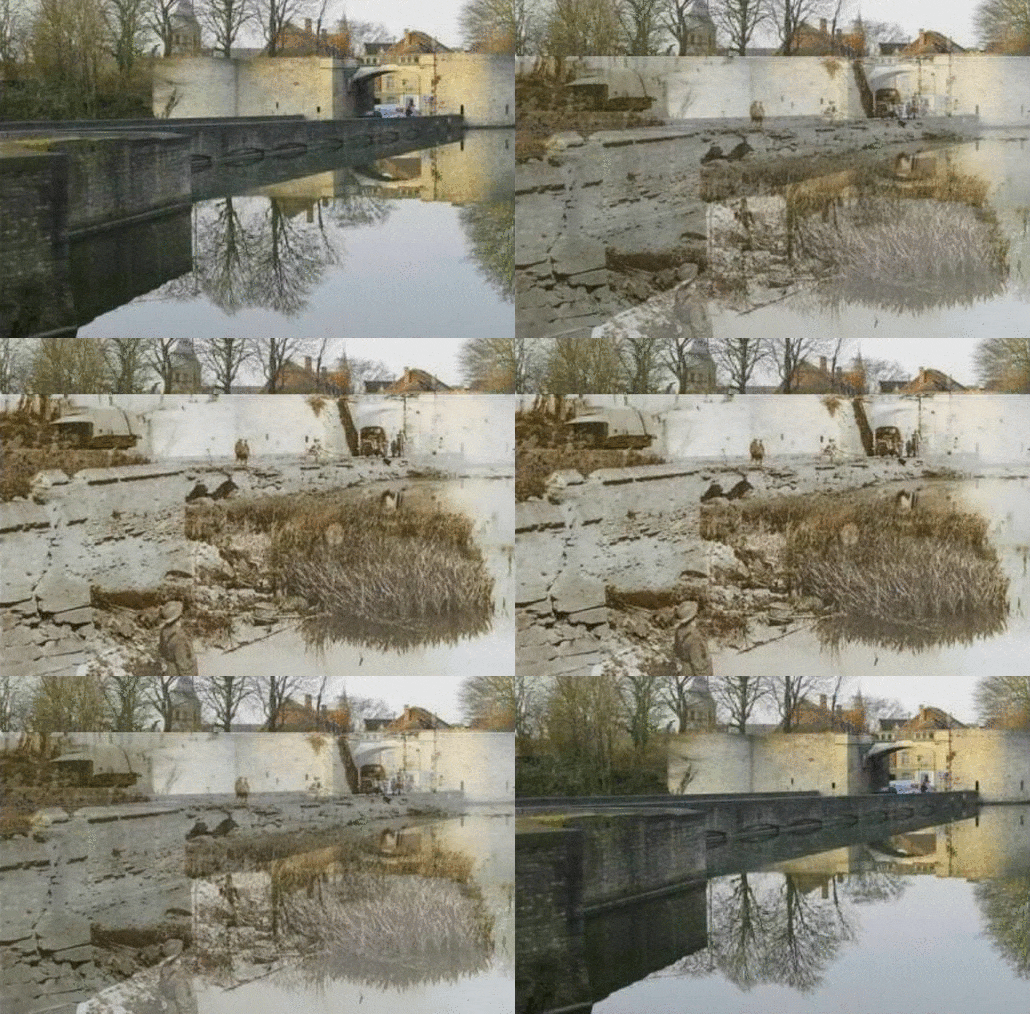

Lille Gate in September, 1917
Looking from the other side, then-and-now

The Ramparts then and now


St. Eloi

 Distant
view of St. Eloi Ridge and Craters, and a photograph of the Crater on
the Bluff looking towards St. Eloi from July, 1916.
Distant
view of St. Eloi Ridge and Craters, and a photograph of the Crater on
the Bluff looking towards St. Eloi from July, 1916.


Blauwepoort Farm CWGC
 Immediately after the war and today.

Railway Dugouts CWGC
 The cemetery just after the war and a near-approximation of the same area.




Reninghelst during the war.


The church, St. Vedastuskerk, taken from 3rd Cdn. Div. H.Q. and today

 Unique iron wreath at the entrance.


 1082 lie here.


Bedford House CWGC
Less than two miles south of the Ypres Lille Gate, this is one of the largest cemeteries in the Salient.

The cemetery shortly after the war, giving some indication of its deceptive enormity.


Chateau
Rosendal, aka Woodcote House, aka Bedford House, before the war, as
depicted in a 1917 sketch, and remains from its ruins within the
cemetery itself.


Brigade H.Q. in in Bedford House, Grounds

Enclosure
no. 2 then and now from the same site. It had started as a burial
ground in December 1915 and used throughout the war until October 1918.
After the Armistice a further 400 graves were moved into this Enclosure
from two British military cemeteries close to the Ypres town centre, the
École de Bienfaissance Cemetery and the Asylum Cemetery.

A
generation later a new inscription had to be added to mark those dead
from another world war, all of them soldiers of the British
Expeditionary Force, who died in the defence of the Ypres-Comines canal
and railway at the end of May 1940.

Zillebeke
village and most of the commune were in the hands of Commonwealth
forces for the greater part of the First World War, but the number of
cemeteries in the neighbourhood bears witness to the fierce fighting in
the vicinity from 1914 to 1918. Bedford House, sometimes known as
Woodcote House, were the names given by the Army to the Chateau
Rosendal, a country house in a small wooded park with moats which still
remain in place as is the drive leading to the chateau, now leading
instead to the cemetery. The ruins of the chateau can distinctly be
viewed within the cemetery. During the First World War the chateau was
used by local British Field Ambulances and Dressing Stations. At an
early stage burials were effected in the grounds. In January 1917 the
chateau was adopted by 55 Brigade as its headquarters until it was
severely damaged by German 8-inch shells (with 500 gas shells falling in
one day during the Third Battle of Ypres). It was used by field
ambulances and as the headquarters of brigades and other fighting units,
and charcoal pits were dug there from October 1917. In time, the
property became largely covered by small cemeteries

Inscribed on the grave of M.H. Ride, died at age 19, September 30, 1915 of the King's Royal Rifle Corps: 'DAD'S BEST PAL'
The entrance with its gates and driveway lined with conifers was in fact for the original 'Bedford House' - the name given by the British to the existing Chateau Rosendal that stood here. Throughout one sees the remains of the building scattered around the site.
The entrance with its gates and driveway lined with conifers was in fact for the original 'Bedford House' - the name given by the British to the existing Chateau Rosendal that stood here. Throughout one sees the remains of the building scattered around the site.

The
grave of Rupert Price Hallowes VC MC of the 4th Bn Middlesex Regiment.
During the fighting at Hooge in the Ypres Salient, Belgium, between the
dates of September 25 to 30, 1915,
2nd Lieutenant Hallowes set a magnificent example to his men under heavy and prolonged bombardments. On more than one occasion he climbed up on the parapet, utterly regardless of danger, in order to put fresh heart into his men. He made daring reconnaissance's of the German positions in our lines. When the supply of bombs was running short he went back under very heavy shell fire and brought up a fresh supply. Even after he was mortally wounded he continued to cheer those around him and to inspire them with fresh courage.
He later died of his wounds and for most conspicuous bravery was posthumously awarded the Victoria Cross on November 16, 1915.

5,139 soldiers either lie buried or commemorated here, over 3,000 of which remain unidentified.
St. Eloi


At a crossroads on the N365 is a Belgian Krupp 95 mm gun and Union flag commemorating the underground mine warfare that took place here at St. Eloi.
The site of many bloody encounters, this marks the spot where the
Germans fired their first mine in March 1915 to counter-attack British
attacks on this position. At the start of the June 7, 1917 attack on
Messines Ridge, the 1st Canadian Tunnelling Company detonated the
largest single charge containing 95, 600 pounds of ammonal. This led to the capture of St Eloi by the British 41st Division.
Trenches: St Eloi
Over the flat slope of St. Eloi
A wide wall of sand bags.
Night,
In the silence desultory men
Pottering over small fires, cleaning their mess-tins:
To and fro, from the lines,
Men walk as on Piccadilly,
Making paths in the dark,
Through scattered dead horses,
Over a dead Belgian's belly.
The German have rockets. The English have no rockets.
Behind the line, cannon, hidden, lying back miles.
Before the line, chaos:
My mind is a corridor. The minds about me are corridors.
Nothing suggests itself. There is nothing to do but keep on.
T. E. Hulme

The
Tunnellers Memorial at the site shown right honours the British,
Canadian and
Belgian sappers who dug the explosive mines detonated under enemy lines
on March 27, 1916. Tunnellers were not infantrymen but their work was
dangerous, harrowing and definitely not for claustrophobes. Sebastian
Faulk's war novel Birdsong includes extended sections conveying all too well how appalling the
work of tunnellers could be.

Turning off of the main road nearby is Bus House CWGC

A mile outside Voormezele is this cemetery standing
behind a farmhouse known as "Bus House" during the war because it was
close to a wrecked London Omnibus which had broken down in no man's
land whilst transporting soldiers to the Front. Clapham mentions it in his memoirs Mud and Khaki:The Memories of an Incomplete Soldier
when in early April 1915 'suddenly out of the darkness in front of us
there loomed up the spectre of a London bus, broken and derelict, but
still standing at the side of the road'.
http://www.ww1battlefields.co.uk/flanders/south.html


Sited
in Zillebeke in West Flanders, some 3 kilometres south-east of Ypres,
Blauwepoort Farm Cemetery is situated in the grounds of the farm bearing
the same name. The cemetery was started by a French battalion of
Chasseurs Alpins in November 1914 for use during the First Battle of
Ypres. It was subsequently used by British forces from February the
following year until February 1916. The cemetery closed in November
1916, with the French graves being removed after the armistice. It
contains 83 British and 7 dominion burials.

Railway Dugouts CWGC

The name derives from the dugouts located in the railway embankment
that was located here during the war. Siting dugouts on the side away
from the Germans protected them from artillery fire. The railway still
passes today, and trains can be seen rushing past the cemetery from
time to time.
One poignant inscription for Pte. Merchant of 58th Bn., Canadian Inf. who died aged only 16 years on June 6, 1916 reads:
"THE ONLY CHILD OF AGED PARENTS"
There
are just under 2,500 buried here, with 400 brought in after the
Armistice who had survived long enough to be sent or brought back from
the front line, but eventually succumbed to their wounds at the Advanced
Dressing Station.

 Among
the graves is that of Frederick Youens VC who was twenty three years
old, and a temporary second lieutenant in the 13th Battalion, The Durham
Light Infantry, British Army during the First World War when the
following deed took place for which he was awarded the VC:
Among
the graves is that of Frederick Youens VC who was twenty three years
old, and a temporary second lieutenant in the 13th Battalion, The Durham
Light Infantry, British Army during the First World War when the
following deed took place for which he was awarded the VC:

On 7 July 1917 near Hill 60, Belgium, it was reported that the enemy were preparing to raid the British trenches and Second Lieutenant Youens, who had already been wounded, immediately set out to rally a Lewis gun team which had become disorganised. While doing this an enemy bomb fell on the Lewis gun position without exploding. The second lieutenant picked it up and hurled it over the parapet, but soon after another bomb fell near the same place and again he picked it up, but it exploded in his hand, severely wounding him and some of his men. The officer later succumbed to his wounds.Youens had been training to become a teacher before the outbreak of the war and had been granted a scholarship to Oxford University.
War debris I came across nearby.
Southeast of Ypres
Larch Wood Railway Cutting CWGC

The
cemetery was founded by Commonwealth troops in April 1915 and
remained in use until April 1918, when the Western Front had moved away
from the area. Most of the dead are from the defence of the nearby
Hill 60. After the Armistice, the cemetery was enlarged with the
concentration of graves from the battlefield, smaller cemeteries in the
area and Commonwealth troops buried in from German war cemeteries.

The
graves of 86 people are defined as "special memorials" in that they
are either recorded as being buried here but the CWGC was unable to
find proof (headstones marked "Believed to be buried in this
cemetery") or they are known to be buried here but their exact
location was lost or destroyed by later fighting (headstones marked
"Known to be buried in this cemetery"). These graves all carry
(unless replaced by a personalised family message) the inscription at
the foot of the stone "Their Glory Shall Not Be Blotted Out" - a
line from Sirach 44:13 suggested by Rudyard Kipling as seen in the
last photograph here.
Oak Dump CWGC

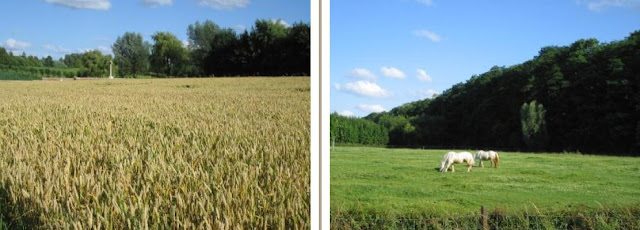
A typical pastoral scene across from and outside the cemetery.

Oak
Dump Cemetery is a few miles south of Ypres on the
Bernikkewallestraat a road leading from the Rijselsesweg (N365)
through the Lille Gate to Armentieres.
It
was made by fighting units in July, August and September 1917 and
one grave of 1914 was brought in after the Armistice. In March 1918 a
sap opposite the cemetery was blown in, and seven men of the 180th
Siege Battery were killed. Their bodies were found in 1927 and buried
in the cemetery. The cemetery now contains 111 Commonwealth burials
of the First World War, five of them unidentified. Two of the graves
destroyed by shell fire are represented by special memorials. The
cemetery was designed by W H Cowlishaw.
Southwest of Ypres
Reninghelst during the war.


The church, St. Vedastuskerk, taken from 3rd Cdn. Div. H.Q. and today
As Alec Paton was passing through Reninghelst he noticed a sign, erected by HQ for the troops, which read 'DO NOT SPEAK TO THE CHINESE.' Underneath, also in large letters, a wit had written, 'WHO THE HELL CAN?'.
THE CHINESE LABOUR CORPS IN FRANCE 1917-1921, BRIAN C FAWCETT
Reninghelst New Military Cemetery

 The
village of Reninghelst was occupied by Imperial forces from the late
autumn of 1914 to the end of the war and was sufficiently far from the
front line to provide a suitable station for field ambulances. The
earliest burials took place in the Churchyard but, in November 1915, the
New Military Cemetery was opened. It remained in use until September
1918. 798 lie buried here.
The
village of Reninghelst was occupied by Imperial forces from the late
autumn of 1914 to the end of the war and was sufficiently far from the
front line to provide a suitable station for field ambulances. The
earliest burials took place in the Churchyard but, in November 1915, the
New Military Cemetery was opened. It remained in use until September
1918. 798 lie buried here.

 An example of a grave immediately after the war and today, standardised. This is of Canadian Lieutenant Arnold Thurston.


 Three
examples of soldiers 'shot at dawn'- Rifleman Barker, shot for for
cowardice November 4, 1916, Private Loader, executed for desertion
August 19 1917, and Private Smith, executed for desertion November 11,
1917
Three
examples of soldiers 'shot at dawn'- Rifleman Barker, shot for for
cowardice November 4, 1916, Private Loader, executed for desertion
August 19 1917, and Private Smith, executed for desertion November 11,
1917
La Clytte Military Cemetery


La Clytte Military Cemetery
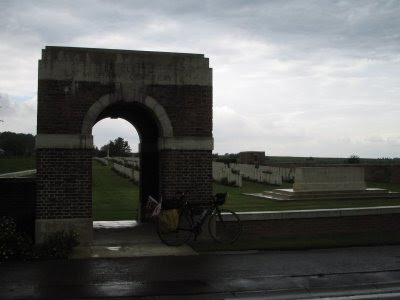
 Unique iron wreath at the entrance.
La Clytte Military Cemetery is
located about five miles southwest of Ypres turning off on the N375
connecting Ypres to Dikkebus, Klijte and on to Loker onto the N304
Klijtseweg.
 1082 lie here.
John Lynn, VC, DCM
On 2 May 1915 near Ypres, Belgium, when the Germans were advancing behind their wave of asphyxiating gas, Private Lynn, although almost overcome by the deadly fumes, handled his machine-gun with great effect against the enemy, and when he could not see them, he moved his gun higher up the parapet so that he could fire more effectively. This eventually checked any further advance and the outstanding courage displayed by this soldier had a great effect upon his comrades in the very trying circumstances. Private Lynn died later from the effects of gas poisoning.
Lynn was recipient of the Cross of the Order of St. George, 4th Class, from Russia.

The Church of Our Lady in what is now De Klijte then and now
Railway Chateau CWGC
 This small cemetery of roughly an hundred graves less than a mile west of Ypres was originally known as Augustine Street Cabaret Cemetery when it was begun in November 1914 as well as L.4 Post Cemetery. 105 lie buried here.


 A
couple of miles south of Ypres at a road junction where three
batteries of Belgian artillery were positioned in 1915 lies 573
casualties. The cemetery was begun by the 8th Division in June 1917
after the Battle of Messines (although one grave in Plot III, Row A,
predates this) and it was used until October 1918, largely for burials
from a dressing station in a cottage near by. Almost half of the
graves are of casualties who belonged, or were attached, to artillery
units. Seven of the burials are unidentified and special memorials
commemorate three casualties known to have been buried in the
cemetery, but whose graves could not be located.
A
couple of miles south of Ypres at a road junction where three
batteries of Belgian artillery were positioned in 1915 lies 573
casualties. The cemetery was begun by the 8th Division in June 1917
after the Battle of Messines (although one grave in Plot III, Row A,
predates this) and it was used until October 1918, largely for burials
from a dressing station in a cottage near by. Almost half of the
graves are of casualties who belonged, or were attached, to artillery
units. Seven of the burials are unidentified and special memorials
commemorate three casualties known to have been buried in the
cemetery, but whose graves could not be located.
 The
graves of two soldiers of undivided India. Among the poignant
inscriptions is this for Private Frederick Charles Nutkins, 6th
Battn. Machine Gun Corps, Infantry:
The
graves of two soldiers of undivided India. Among the poignant
inscriptions is this for Private Frederick Charles Nutkins, 6th
Battn. Machine Gun Corps, Infantry:
 This small cemetery of roughly an hundred graves less than a mile west of Ypres was originally known as Augustine Street Cabaret Cemetery when it was begun in November 1914 as well as L.4 Post Cemetery. 105 lie buried here.

Some graves have two to a plot.
Belgian Battery Corner CWGC

A brave boy
and a good son.
Sadly missed,
remembered by all.
and a good son.
Sadly missed,
remembered by all.

Photograph of the Belgian Battery Corner First Aid Dressing Station


